Freedom National: The Destruction of Slavery in the United States, 1861-1865 by Oakes James
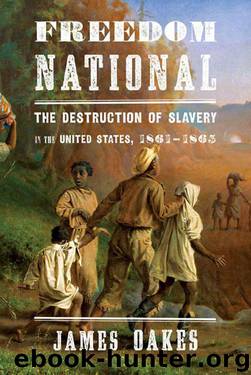
Author:Oakes, James [Oakes, James]
Language: eng
Format: epub, azw3
Publisher: Norton
Published: 2012-12-10T08:00:00+00:00
WAITING FOR THE PROCLAMATION
Even before he signed the Second Confiscation Act on July 17, Lincoln was being pressured to proclaim universal emancipation based on his war powers alone. More and more northerners were coming to the conclusion that only the complete destruction of slavery would end the rebellion. Protestant congregations and synods mobilized to urge the president’s endorsement of universal emancipation in the spring of 1862. Let “liberty be proclaimed throughout the land,” their petitions and resolutions declared, “to all the inhabitants thereof.” Freedom throughout the land had become a common theme among antislavery Christians. A Methodist minister in Pennsylvania forwarded a “Petition for emancipation” to President Lincoln, urging him to exercise his power as commander in chief to “proclaim ‘liberty through all the land.’ ” In June a Quaker petition arrived at the White House urging Lincoln “not to allow the present golden opportunity to pass without decreeing the entire abolition of slavery throughout the land.” Calls for presidential decrees and proclamations were pouring into the White House even before Congress authorized the president to free the slaves of rebels.12
The Lincoln legend tells of a president who waited patiently for public opinion to catch up with him. In fact, as soon as Lincoln signed the Second Confiscation Act, he was bombarded with calls to issue the proclamation immediately. When the announcement failed to emerge from the cabinet meeting of July 22, newspapers published misleading reports claiming that Seward and Blair objected so strenuously to emancipation that they dissuaded the president from issuing it. Only a day after the cabinet met, the radical reformer Robert Dale Owen wrote to Lincoln warning him that in times of national emergency “it may be as dangerous to disappoint, as to conciliate, public opinion. And I confess my fears for the result, if decisive measures are much longer delayed.” Warning that “every day’s delay” strengthens the rebels, one group after another began petitioning the president “to act in his capacity as Commander in Chief” by issuing “the Proclamation of Emancipation.” By the middle of August, Sydney Howard Gay, the managing editor of the influential New York Tribune, explained to Lincoln that there were many people in the North “who are anxiously awaiting that movement on your part which they believe will end the rebellion by removing its cause.” The pressure on the president was mounting.13
Gay’s letter may have been prompted by reports appearing in that day’s papers of a meeting Lincoln had held the day before with a delegation of black leaders from Washington. This was not the first time Lincoln had met with black leaders, but it was an extraordinary encounter all the same. Hoping to build support for the voluntary emigration of freed slaves, Lincoln asked his commissioner of colonization, the Reverend James Mitchell, to arrange for a group of black leaders from the District area to meet with him in the White House on August 14, 1862.
Lincoln’s behavior was shocking. Normally a good listener, on this occasion he instead read his guests a high-handed statement that was insulting in both its tone and its substance.
Download
Freedom National: The Destruction of Slavery in the United States, 1861-1865 by Oakes James.azw3
This site does not store any files on its server. We only index and link to content provided by other sites. Please contact the content providers to delete copyright contents if any and email us, we'll remove relevant links or contents immediately.
| Africa | Americas |
| Arctic & Antarctica | Asia |
| Australia & Oceania | Europe |
| Middle East | Russia |
| United States | World |
| Ancient Civilizations | Military |
| Historical Study & Educational Resources |
Cat's cradle by Kurt Vonnegut(15355)
Pimp by Iceberg Slim(14508)
4 3 2 1: A Novel by Paul Auster(12393)
Underground: A Human History of the Worlds Beneath Our Feet by Will Hunt(12099)
The Radium Girls by Kate Moore(12028)
Wiseguy by Nicholas Pileggi(5786)
The Fire Next Time by James Baldwin(5446)
Perfect Rhythm by Jae(5404)
American History Stories, Volume III (Yesterday's Classics) by Pratt Mara L(5308)
Paper Towns by Green John(5191)
Pale Blue Dot by Carl Sagan(5008)
A Higher Loyalty: Truth, Lies, and Leadership by James Comey(4964)
The Mayflower and the Pilgrims' New World by Nathaniel Philbrick(4504)
The Doomsday Machine by Daniel Ellsberg(4490)
Killers of the Flower Moon: The Osage Murders and the Birth of the FBI by David Grann(4447)
The Sympathizer by Viet Thanh Nguyen(4390)
Too Much and Not the Mood by Durga Chew-Bose(4348)
The Borden Murders by Sarah Miller(4325)
Sticky Fingers by Joe Hagan(4199)
